

For the modern Australian decision-maker, CEOs, CISOs, and Business Owners alike, the conversation around cyber security has shifted. It is no longer a technical checkbox exercise hidden in the basement of the IT department. It has become a core pillar of corporate governance, financial stability, and brand reputation.
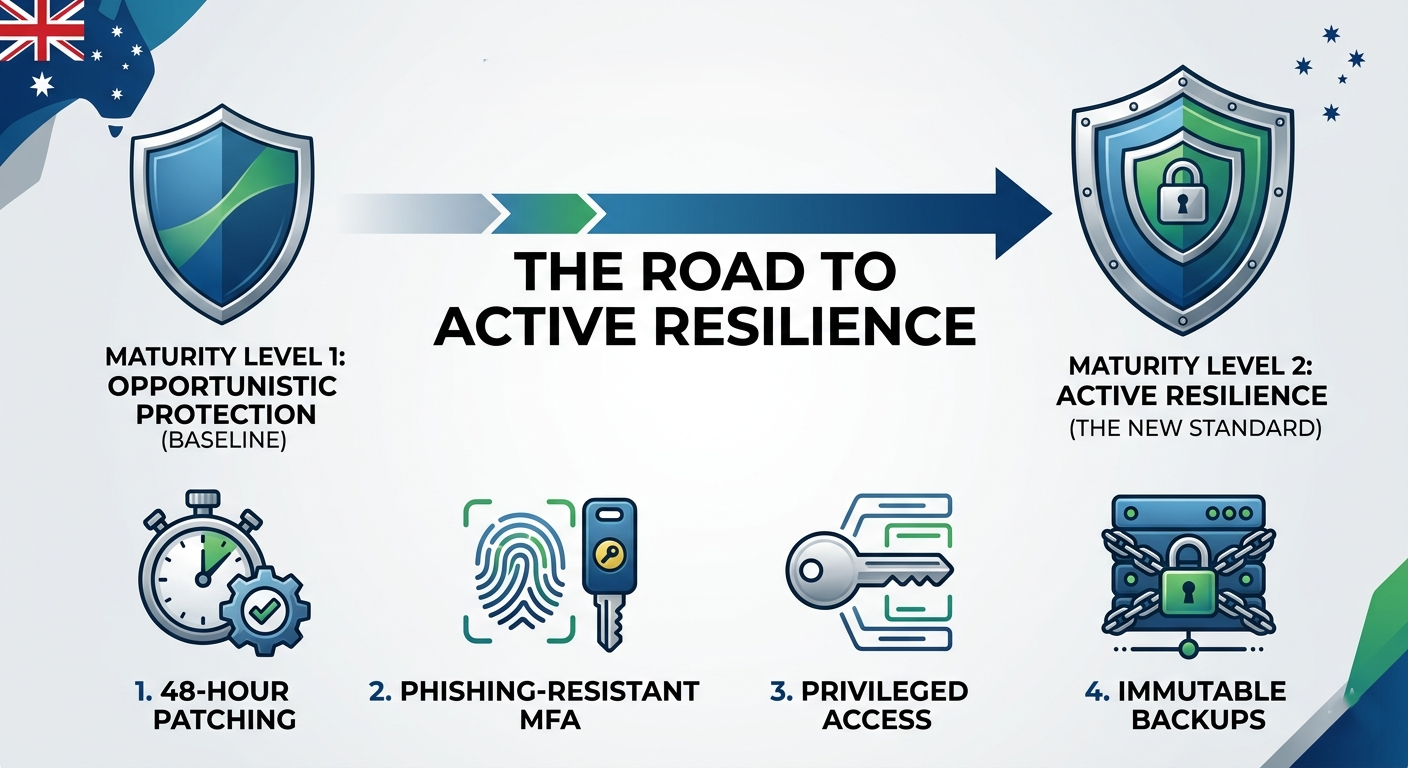
As we navigate an increasingly complex digital landscape, the Australian Signals Directorate (ASD) and the ACSC have provided a clear roadmap, the Essential 8 (E8). While many organizations initially aimed for Maturity Level 1 to cover the basics, the goalposts have moved. Essential 8 Maturity Level 2 is the new line in the sand for the modern and higher-risk environment. It is the point where an organization moves from opportunistic protection to active resilience.
But why is this evolution so critical? And what does it look like for a business trying to balance growth with security? Let’s pull back the curtain on why Essential 8 Maturity Level 2 is the non-negotiable standard for the modern enterprise.
1. The 48-Hour Race – Redefining Automated Patch Management
One of the most significant changes in recent years is the speed at which vulnerabilities are weaponized. In the past, you might have had weeks to test a patch before deployment. Today, some players use automated scanning tools to find unpatched systems within hours of a vulnerability being announced.
The Level 2 Mandate
Under the Maturity Level 2 requirements, “Extreme Risk” vulnerabilities in internet-facing services must be patched within 48 hours. For a decision-maker, this is an operational challenge. If your team is still relying on manual patching or a “wait and see” approach, you are effectively leaving your front door wide open.
- The Investment: Achieving Level 2 requires automated patch management tools. This isn’t just about security, it’s about efficiency. Automated systems reduce the manual burden on your IT staff, allowing them to focus on high-value projects rather than chasing updates.
- The Risk: A single unpatched VPN gateway or server can become patient zero for a company-wide ransomware event.
2. Identity is the New Perimeter – Beyond Standard MFA
We’ve all heard the stories: a company was breached despite having Multi-Factor Authentication (MFA). How? Because not all MFA is created equal. Common tactics like Session Hijacking and Adversary-in-the-Middle (AiTM) attacks allow hackers to bypass traditional SMS codes or push notifications. They don’t need your password, they just need to trick an employee into clicking a link that steals their active “login token.”
Phishing-Resistant MFA – The Gold Standard
To reach Essential 8 Maturity Level 2, the focus shifts to Phishing-Resistant MFA. This is a critical pivot in this framework that moves away from easily interceptable codes.
- FIDO2 Security Keys: Physical USB or NFC keys that require a physical touch to authenticate.
- Windows Hello for Business: Using biometric data tied directly to the hardware Trusted Platform Module (TPM).
- The Outcome: This makes it mathematically impossible for a remote hacker to “phish” a user’s credentials. For the board, this is the single most effective way to protect executive identities and sensitive corporate data.
3. Containing the Fire – Privileged Access Management (PAM)
One of the most dangerous elements of a cyber-attack isn’t the initial entry, it’s the lateral movement. This occurs when a hacker gains access to a low-level account and then “hops” through the network until they find administrative credentials.
Restricting Administrative Privileges
Essential 8 Maturity Level 2 takes a hard line on Privileged Access Management (PAM). It demands a level of “least privilege” that prevents a single compromised workstation from taking down a global network.
- No “God Accounts”: Administrative accounts must never be used for daily tasks like checking email or web browsing.
- Separate Environments: Admins must use a dedicated, isolated environment for sensitive tasks.
- Audit Logs: Every action taken by an admin is logged and monitored.
By restricting these privileges under the Essential 8 Maturity Level 2 guidelines, you ensure that even if an employee clicks a malicious link, the damage is contained. The “fire” cannot spread to your core servers or financial systems.
Strategic Resources from Our Expert Team
- Cybersecurity Advisory – Strategic Guidance for CIOs: Learn how to navigate the increasingly complex landscape of digital transformation.
- Cyber Security Audit – A Practical Roadmap: A deep dive into why an audit is the first step toward defending against ransomware.
4. The Macro Problem – Securing the Productivity Suite
Microsoft Office Macros are a double-edged sword. They drive automation in finance and logistics, but they are also a favorite delivery vehicle for ransomware.
Trusted Publisher Models
At Maturity Level 1, you might just “block macros from the internet.” But Essential 8 Maturity Level 2 requires a more sophisticated Trusted Publisher approach.
- Continuity: Your team can still use the macros they need for work.
- Validation: However, those macros must be digitally signed by a trusted authority.
- Security: The system blocks any unsigned or suspicious macro by default, removing the “human error” of an employee clicking “Enable Content” on a fake invoice.
5. Application Control – The “Invitation Only” Network
Most security software works by trying to identify bad programs. But in a world where new malware is created every second, this “blocklist” approach is always one step behind. Application Control flips the logic. It uses an Allowlist.
At Essential 8 Maturity Level 2, only pre-approved, digitally signed software is allowed to run on your workstations and servers. If a piece of software isn’t on the list, whether it’s a new productivity tool a staff member downloaded or a malicious script, it simply won’t execute. This is the ultimate “safety net” for your digital infrastructure and a core requirement for those pursuing Maturity Level 2 certification.
6. Resilience – When Backups Become Your Last Line of Defense
No matter how strong your walls are, you must plan for the day they are breached. This is where Regular Backups transition from a “backup plan” to a “recovery strategy.” In recent years, ransomware has evolved to target backups first. If a hacker can delete your backups, they hold all the cards.
The Level 2 Requirement – Immutable Backups
Essential 8 Maturity Level 2 requires Immutable or Segmented Backups. This means your data is stored in a way that it cannot be altered or deleted, even by someone with administrator rights, for a set period.
- Testing: It’s not enough to have backups. Essential 8 Maturity Level 2 requires regular, documented restoration tests to prove that you can get your business back online in hours, not weeks.
Feature |
Maturity Level 1 |
Maturity Level 2 |
|
Backup Storage |
Online/Local |
Offsite/Cloud/Immutable |
|
Restoration Testing |
Ad-hoc |
Regular & Documented |
|
Access Control |
Standard Admin |
Restricted/MFA Protected |
7. The Boardroom View – Compliance, Insurance, and Liability
Why should the C-suite care about Essential 8 Maturity Level 2? Because the commercial landscape has changed.
Cyber Insurance Eligibility
The insurance market is no longer lenient. To secure a policy in the current market, or to ensure a claim is paid out after an event, insurers are increasingly mandating Essential Eight Maturity Level 2 compliance. Without it, you may find your business uninsurable or facing astronomical premiums.
Director Liability in Australia
Under the Privacy Act and emerging regulations, cybersecurity is now a Director-level responsibility. Demonstrating a commitment to a recognized framework like the Essential 8 is your best defense against claims of negligence. Adhering to Essential 8 Maturity Level 2 shows that the organization has taken “reasonable steps” to protect its data, its people, and its shareholders.
8. Navigating the Gap – A Consultative Approach
Achieving Essential 8 Maturity Level 2 is not about buying more software, it’s about aligning your people, processes, and technology. Many organizations struggle because they try to “boil the ocean.” They attempt to reach Level 3 in one area while being at Level 0 in another. The ACSC recommends a balanced uplift, getting all eight strategies to Level 1, then all to Essential eight Maturity Level 2.
The Maturity Gap Analysis
Where does your organization sit today?
- Are you relying on “standard” MFA while your competitors have moved to phishing-resistant hardware?
- Is your patching cycle measured in days or weeks?
- Could a single compromised admin account take down your entire backup repository?
Final Thoughts – The Cost of “Good Enough”
In the current cyber climate, Good Enough is the enemy of Secure.” The jump from Level 1 to Essential 8 Maturity Level 2 is the most significant leap a business can take to protect its bottom line. It moves your security from a reactive posture to a resilient one.
Cyber security is not a destination, it is a continuous state of readiness.
Ready to Deepen Your Information?
Understanding the framework is one thing, implementing Essential Eight Maturity Level 2 without disrupting your daily operations is another. If you are looking for a deep-dive assessment or want to understand how these maturity levels apply to your specific industry and infrastructure, don’t rely on generic checklists.
I don’t believe in one-size-fits-all security. If you need detailed information or professional consulting to bridge the gap to Essential 8 Maturity Level 2, talk to me directly or DM me. Let’s have a candid conversation about your current posture and build a roadmap that protects your business while supporting your growth.
Reach out today for a consultation on your Essential 8 strategy.