

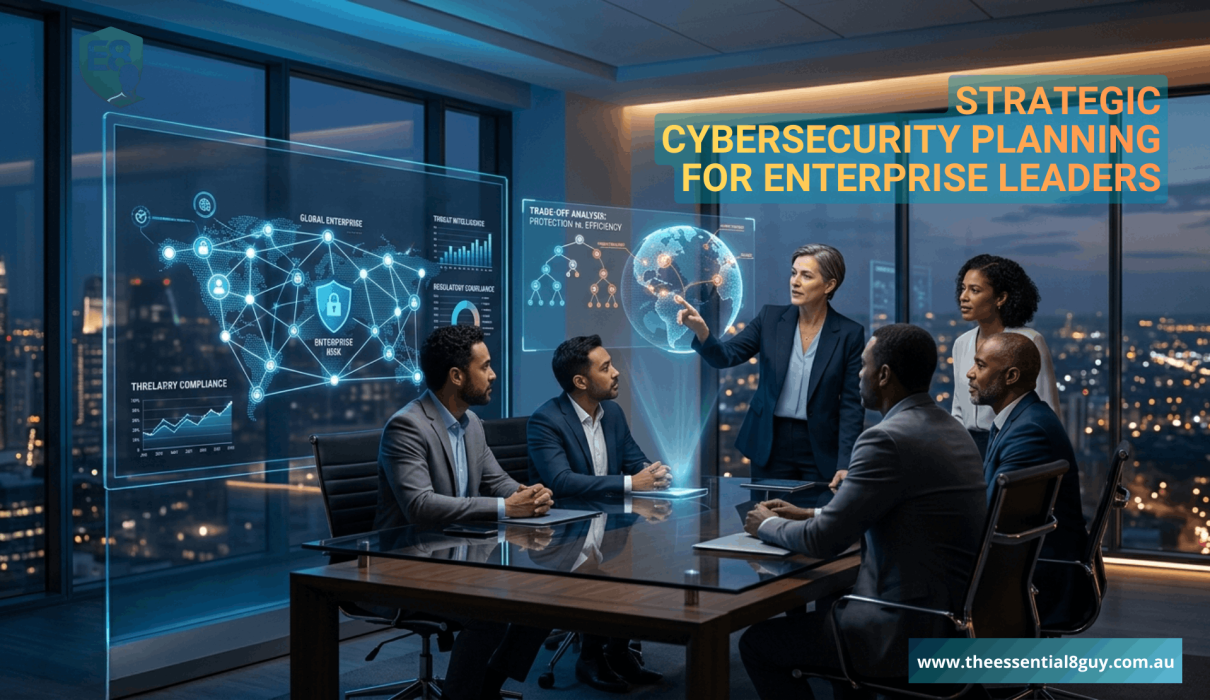
2026 brings an increasingly complex cybersecurity landscape. Organisations are navigating rapid digital transformation, hybrid cloud adoption, remote work expansion, and increasingly sophisticated cyber threats. Every decision, technology adoption, investment allocation, policy updates, carries significant implications.
For executives, cybersecurity is no longer just operational, it is strategic. Every choice involves trade-offs: balancing protection, compliance, operational efficiency, and business growth. In this environment, a cybersecurity advisory is invaluable. It doesn’t prescribe a one-size-fits-all solution… rather, it enables leaders to reflect, weigh options, and make decisions with confidence.
A cybersecurity advisory allows organisations to:
- Understand their true exposure to enterprise cyber risk
- Evaluate emerging technologies and mitigation strategies
- Align security initiatives with business priorities and regulatory obligations
- Make considered, high-impact decisions that deliver both security and operational resilience
Framing Enterprise Cyber Risk
Risk is rarely binary. Decisions often involve weighing probability against impact and prioritising where to allocate limited resources. Cybersecurity advisory services help executives view risk in context, asking questions such as:
- Which systems, data assets, or processes are most critical to ongoing operations?
- Which threats could have material financial, reputational, or operational impact?
- Which mitigation strategies provide maximum risk reduction per dollar invested?
By considering these factors, leaders can make strategic decisions that are deliberate, measurable, and aligned with organisational priorities, rather than reacting to noise or fear-driven scenarios.
Aligning Security Decisions with Organisational Goals
Cybersecurity cannot exist in isolation. Each control, process, or investment affects operations, productivity, and innovation. Advisory guidance helps executives consider the broader implications:
- Does adopting a new security framework enable growth or create friction with operations?
- How does regulatory compliance intersect with business objectives?
- Are security initiatives enhancing trust among stakeholders, partners, and customers?
- Which trade-offs are acceptable in terms of cost, time, and operational impact?
Through this lens, cybersecurity decisions become strategically aligned, supporting resilience without hindering agility or innovation.
For a broader perspective on how organisations are adapting their defensive strategies, you may also find our Cybersecurity Tips for 2026 enterprise protection insights valuable when evaluating evolving cyber risks.
Evaluating Technology Adoption Strategically
Emerging technologies, AI-driven detection, zero-trust architecture, cloud security frameworks, and automation tools, offer significant benefits, but implementation is rarely simple. Advisory services guide executives to evaluate adoption carefully:
- Which technologies reduce enterprise cyber risk most effectively?
- What operational or cultural adjustments will adoption require?
- How compatible is a solution with existing infrastructure and processes?
- Does it provide scalable, long-term protection as threats evolve?
Consider a CIO evaluating a zero-trust framework. Advisory insight helps them reflect not just on deployment cost, but on how workflows, user experience, and operational efficiency may shift. These considerations allow leaders to make informed, strategic decisions rather than adopting technology reactively.
Incident Preparedness and Governance Reflection
Preventive measures are never enough; incidents are inevitable. Advisory guidance encourages leaders to reflect on potential scenarios and decision-making pathways before a crisis occurs:
- Are escalation protocols clear and aligned with organisational priorities?
- How will stakeholders, clients, and regulators be informed if incidents occur?
- Which actions will minimise operational and reputational impact?
- How will resources be allocated under pressure to maintain continuity?
By considering these questions proactively, organisations can respond decisively when incidents occur, reducing risk while maintaining trust and confidence.
Considering Emerging Cyber Threats
The cyber threat landscape evolves constantly. Advisory insight helps organisations reflect strategically:
- Which threats pose the greatest operational and financial risk in the next 12–24 months?
- Are mitigation strategies prioritised based on impact versus probability?
- How should resources be allocated between training, detection, and response capabilities?
- Are we considering low-probability, high-impact events in long-term planning?
For example, AI-powered phishing campaigns or supply chain attacks can be difficult to predict. Advisory reflection allows leaders to consider potential scenarios and evaluate mitigation strategies, instead of reacting only after a threat manifests.
Compliance and Governance Considerations
Regulatory requirements are complex, and adherence is more than a checklist. Cybersecurity advisory helps executives consider the implications of compliance:
- Which regulatory obligations carry the greatest risk if unmet?
- Do current controls meet the intent of the law, rather than just procedural requirements?
- Are governance frameworks flexible enough to adapt as threats and regulations evolve?
This approach ensures compliance initiatives are strategically integrated, reinforcing resilience without unnecessary operational burden.
Strategic Reflection and Decision Support
The value of a cybersecurity advisory lies in enabling reflective, high-confidence decision-making:
- Evaluating options before allocating resources or budget
- Considering operational, cultural, and financial implications of each decision
- Aligning technology adoption, risk mitigation, and compliance with strategic goals
- Prioritising decisions that maximise resilience and business continuity
This deliberate evaluation helps organisations avoid reactive measures and build a sustainable security posture.
Emerging Trends to Consider in 2026
Executives benefit from evaluating trends strategically:
- AI and Machine Learning: Evaluate practical ROI and operational impact for threat detection
- Cloud Security: Consider multi-cloud and hybrid deployments with risk and performance implications
- Zero Trust Architecture: Assess feasibility and user adoption challenges
- Threat Intelligence: Consider ransomware, phishing, and APT evolution
- Automation and Orchestration: Determine which processes improve efficiency and incident response
By considering these elements, organisations ensure technology investments deliver long-term, measurable protection.
Benefits of Consideration-Focused Advisory
- Strategic Clarity: Understand implications and trade-offs before acting
- Confidence in Investment: Evaluate costs, operational impact, and benefits
- Resource Optimisation: Direct effort to highest-value controls
- Preparedness for Incidents: Consider scenarios and response strategies
- Alignment with Business Objectives: Ensure every choice supports long-term organisational priorities
A reflection-based approach ensures cybersecurity is a strategic enabler, not just a defensive measure.
Conclusion
Cybersecurity in 2026 is not merely operational, it is strategic, complex, and high-stakes. Advisory services help organisations reflect, evaluate, and make informed decisions:
- Understanding enterprise cyber risk in context
- Aligning technology, compliance, and governance with organisational priorities
- Preparing for incidents with deliberate consideration
- Evaluating emerging threats and strategic options
When approached thoughtfully, cybersecurity transforms into a strategic advantage, supporting resilience, trust, and sustainable growth.
Take the Next Step with Cybersecurity Advisory
Organisations seeking to strengthen cybersecurity in 2026 can benefit from advisory support that promotes reflection, evaluation, and strategic alignment.
Advisory services help leaders:
- Examine enterprise risk contextually
- Consider regulatory compliance strategically
- Evaluate technology adoption options
- Reflect on incident preparedness
- Make deliberate, high-confidence decisions
Get in touch or DM me today to explore how advisory insight can turn cybersecurity into a strategic, considered advantage.